Showing posts with label Healthcare. Show all posts

Monday, March 23, 2015

Who had health insurance coverage pre-2014?

by Lecia Parks Langston, Senior Economist

Recent tax filers undoubtedly noticed something new on their 2014 federal tax form. For the first time, the “shared responsibility” provision of the Affordable Care Act required individuals to have qualifying health coverage, qualify for a coverage exemption, or make a shared responsibility payment when filing tax returns. The U.S. Census Bureau’s recently released health insurance (2008-2013) estimates provide a baseline of health insurance coverage before the Affordable Care Act individual shared responsibility requirements. In future years, the effects of the Affordable Care Act will be apparent in this data series.

This data is based on modeled American Community Survey estimates and administrative data. It allows analysis of differences in coverage by demographics at the county level. In addition to statewide data, the following visualization provides an interactive method to view coverage at the county level.
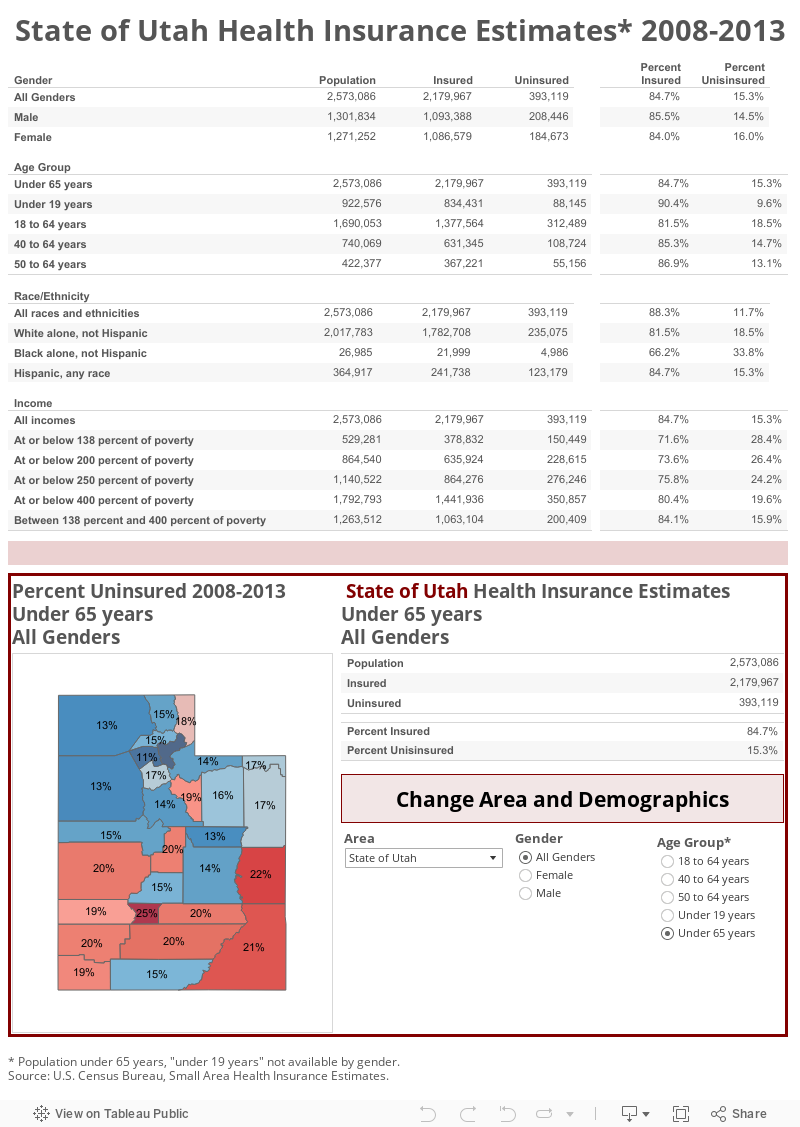

Keep in mind that government-provided healthcare coverage (such as Medicaid) is included. What do these figures tell us about health insurance coverage for Utahns under the age of 65 prior to 2014?

• Roughly 15 percent of Utah’s population under age 65 did not have health insurance between 2008 and 2013.

• Utah women were slightly less likely (84 percent) than Utah men (86 percent) to maintain healthcare coverage.

• Young people under the age of 19 were most likely to be covered by health insurance. More than 90 percent had coverage.

• Of the reported racial/ethnic groups, Hispanics showed the highest rates of healthcare coverage.

• In Utah, the lower incomes translated into lower shares of insured individuals.

• In general, Utah counties in the southern half of the state showed the highest shares of uninsured.

• Piute County’s estimate indicates that one-fourth of its population did not maintain healthcare coverage, the highest uninsured rate in Utah.

• Morgan County showed the highest percentage of insured individuals (90 percent).

Tuesday, September 17, 2013

Income, Poverty and Health Insurance Coverage in the United States: 2012

The U.S. Census Bureau announced today that in 2012, real median household income and the poverty rate were not statistically different from the previous year, while the percentage of people without health insurance coverage decreased.

Median household income in the United States in 2012 was $51,017, not statistically different in real terms from the 2011 median of $51,100. This followed two consecutive annual declines.

The nation’s official poverty rate in 2012 was 15.0 percent, which represents 46.5 million people living at or below the poverty line. This marked the second consecutive year that neither the official poverty rate nor the numbers of people in poverty were statistically different from the previous year’s estimates. The 2012 poverty rate was 2.5 percentage points higher than in 2007, the year before the economic downturn.

The percentage of people without health insurance coverage declined to 15.4 percent in 2012 ─ from 15.7 percent in 2011. However, the 48.0 million people without coverage in 2012 were not statistically different from the 48.6 million in 2011.

These findings are contained in the report Income, Poverty, and Health Insurance Coverage in the United States: 2012. The following results for the nation were compiled from information collected in the 2013 Current Population Survey (CPS) Annual Social and Economic Supplement (ASEC). The CPS-ASEC was conducted between February-April 2013 and collected information about income and health insurance coverage during the 2012 calendar year. However, the information on shared households pertains to the circumstances at the time of the survey. The CPS-based report includes comparisons with one year earlier. State and local results will be available on Thursday from the American Community Survey.

Friday, August 30, 2013

Census Bureau Releases Health Insurance Coverage Estimates for All Counties

The Census Bureau today released its 2011 Small Area Health Insurance Estimates (SAHIE). The estimates show the number of people with and without health insurance for all states and each of the nation’s roughly 3,140 counties. The statistics are provided by broad age group, sex, race and Hispanic origin, and at income levels that reflect thresholds for state and federal assistance programs. The data can be used to assess annual changes in health insurance coverage from 2008 through 2011.

The release includes a 2011 highlights document that describes demographic and economic differences in health insurance status across states and counties, as well as geographic variation and time trends in health insurance status. The document also includes a number of maps that are available for download from the SAHIE website.

SAHIE can be a useful tool when evaluating the impacts of health care policy changes at the state and county levels. SAHIE provides estimates of the uninsured at incomes 0 to 138 percent of the federal poverty threshold. This group may qualify for Medicaid in participating states. The 0 to 400 percent group provides estimates of the uninsured population that may qualify for the Health Insurance Exchanges or for Medicaid. To make quick evaluations of your state’s potential program participants, visit the SAHIE interactive data and mapping tool on the SAHIE website. The tool allows users to create and download state and county custom tables and thematic maps, and state health insurance coverage time trend charts. U.S. Census Bureau

Related post: Utah's Labor Market and Economy Blog

Thursday, June 27, 2013

Utahns to receive health insurance rebates

U.S. Health and Human Services Secretary Kathleen Sebelius announced Thursday that about 140,000 Utahns will be receiving a rebate this year from their health insurance company. Utah residents will benefit from more than 4.5 million dollars in rebates from insurance companies this summer, averaging 85 dollars per family.

The rebates are a result of the federal Affordable Care Act’s Medical Loss Ratio Standard known as the 80/20 rule. It requires insurers to spend at least 80 cents of every premium dollar on patient care and quality improvement. If they spend an excessive amount on profits and red tape, they owe rebates back for the difference. Insurance companies that do not meet the 80/20 standard will send consumers a notice that they are eligible for the rebate by August 1st. KUER

Friday, May 17, 2013

Health insurance tax and small‐business owners

Many small-business owners worry that a new tax on insurance providers in the health-care law will mean higher premiums for them, undermining the law’s capacity to lower their health-care costs.

Starting next year, the federal government will charge a new fee on health insurance firms based on the plans they sell to individuals and companies, known as the fully insured market. Meanwhile, the provision exempts health-insurance plans that are set up and operated by businesses themselves (the self-insured market).

The Department of Health and Human Services reports that among private businesses that offer health insurance, three of every four firms with between 100 and 500 employees purchase coverage in the fully insured market. The number jumped to 87 percent for firms with fewer than 100 workers.

The concerns from small-business owners and insurance companies have prompted lawmakers to introduce bills that would repeal the health insurance tax.

Business lobbying groups from the manufacturing, construction and farming sectors have supported those efforts, citing similar concerns about the likely impact on their health insurance premiums. Washington Post

Friday, April 12, 2013

State-by-state costs of health care

Today’s Wall Street Journal has a story and graphics on state-by-state costs of health care. Compiling data from the Centers for Medicare and Medicaid Services, the Census Bureau and the Centers for Disease Control and Prevention, it shows that Massachusetts is the most expensive state and Utah is the cheapest. Wall Street Journal


Wednesday, April 10, 2013

Analysis on the Affordable Care Act

A new analysis from FactCheck.com on the Affordable Care Act shows that not much will be different as the law is put into place for those who get insurance through their employers, and that’s the bulk of Americans. The Society of Actuaries/Lewin Group report estimates that those with employer-based insurance will decline by 2 million because of the law, for a total of 155 million people.

The analysis estimated that for the individual, or nongroup, market, the “cost per member per month will increase 32 percent under ACA, compared to pre-ACA projections.” But that’s costs for insurance companies, not an increase in premiums. In fact, the report didn’t attempt to estimate what the change might be in premiums.

Instead, it said: “We focused only on the changes in allowable costs. Actual premiums will vary for each insurer based on many factors which are beyond the scope of this report, since each insurer will have different circumstances and strategies with regard to competition.”

It’s true that insurers, like any other business, could pass along any increased costs to customers, in this case policyholders. So if costs go up, premiums would likely go up.

The report notes that the costs will vary by state, with states that already limit premium variability based on age or health status – known as community rating – not seeing much of an increase. In fact, their costs could decrease, as “younger and healthier individuals … will enroll due to the reduced cost from the premium subsidies,” the report says. States without community rating will experience an increase in costs as older and sicker individuals who previously didn’t have insurance are able to get it.

While the Congressional Budget Office said that the average premium per person in the individual market would go up by 10 percent to 13 percent because of the health care law, it added that for most, subsidies would push their costs “well below” what they would have been charged in the absence of the law. In its latest report, the CBO says about 80 percent of an estimated 25 million joining the exchanges by 2023 will receive subsidies.

But plans on the individual market will, overall, have much better benefits because of the law than they do now. That’s why the CBO expects premiums on average to go up.

One could glean from the CBO report that plans with the same level of benefits (i.e., good benefits) would cost less on the individual market because of the law than they would have otherwise, but those on the individual market largely don’t have those plans now anyway.

Beyond that, no one is actually going to save money compared with what they’re paying now — the estimates pertain to what premiums will cost in the future compared with what they would have cost without the law. And without the law, premiums would still be going up. FactCheck

Friday, April 5, 2013

Many Americans fail to grasp health care reform

A survey done for InsuranceQuotes.com by Princeton Survey Research Association International found that 90 percent of Americans don’t know when they’ll be able to start shopping for insurance through the exchanges, and only 10 percent say they’re very knowledgeable about the federal Patient Protection and Affordable Care Act.

But that information should get out soon because state and federal agencies will use “aggressive” communications campaigns to publicize open-enrollment dates and other significant information. The campaigns likely will include print ads, social media initiatives, TV commercials, billboards and community outreach, she says.

But the health care reform law is complicated, and Amy Bach, executive director of the nonprofit consumer group United Policyholders says consumers who put off learning more about their options might end up pressed to make an important decision in a short time.

To avoid being in that position, consumers might want to consider these four tips for shopping under the new system:

Learn about the law. If your knowledge of the health care reform law is shaky, there’s still time to learn. Consumers can start by visiting healthcare.gov.

Start shopping early. If you don’t have health insurance, or if you bought individual insurance but want to switch plans, you’ll need to go shopping.

Be detail-oriented. Consumers should find out exactly what different plans cover and should carefully add up costs, including deductibles and co-pays, before deciding which plan is the best fit.

Choose carefully. Consumers should get help from several sources when trying to decide on a health plan, Bach says. For example, she recommends consumers talk to an experienced health insurance broker. Insurance Quotes

Friday, March 22, 2013

Most of U.S. flunks health price transparency test: study

Twenty-nine states get a failing grade for price transparency in health care, while another six get a “D” grade, according to a study released Monday.

The 53-page joint report from the Health Care Incentives Improvement Institute and the Catalyst for Payment Reform, examined the strength of legislation requiring health price transparency. Only two states, Massachusetts and New Hampshire, earned an “A”. Utah was one of seven who earned a “C”.

While no state has implemented laws that meet all of their criteria, they graded on a curve to recognize the states with the most advanced laws to date. They expect that the curve will shift as transparency becomes more of a priority nationally.

You can read the report here.

Wednesday, February 20, 2013

Utah hospitals absorb $698 million in unpaid bills

The economy appears to be on the mend, but Utah’s hospitals are getting no relief from demand for free and discounted care.

As ranks of uninsured and underinsured swell, the state’s four major health systems have seen their uncompensated care — charity care plus unpaid bills — more than triple in nine years, to $698 million in 2012.

Nonprofit Intermountain Healthcare alone forgave more than half a billion dollars in charges. So at what point do hospitals insist that Utah expand Medicaid to cover more of the state’s uninsured?
Utah leaders are undecided about whether to stretch Medicaid in 2014 to cover an estimated 58,000 uninsured adults.


The federal government will pick up the entire bill for new enrollees the first three years, and at least 90 percent of the expenses after that, totaling $4.1 billion between 2014 and 2019.

But the state’s portion is considerable and predicted to mount to $174 million by 2020, and possible more if the deficit forces Congress to trim entitlement spending.

Lawmakers, industry leaders and advocates are awaiting the unveiling of a state-commissioned cost study by Public Consulting Group, which has been delayed twice.

The economics of a Medicaid expansion make it a no-brainer, consumer advocates argue.

Federal Medicaid dollars generate rounds of spending as hospitals staff up and invest in equipment upgrades, and as health care workers spend their earnings on restaurants and cars.

Hospital executives agree that covering the uninsured is a good for public health and their bottom lines. The most recent earnings forecast for HCA, owner of Utah’s for-profit MountainStar Hospitals, fell short of analysts’ expectations as revenue gains were overshadowed by unpaid patient bills.
On a national level, HCA supports expanding Medicaid.

But Utah’s uninsured rate isn’t as high as in other states, "which is why we are working with other health care providers [to find] … solutions that help in the short term and are sustainable in the long run," said MountainStar spokeswoman Audrey Glasby.

Unpaid care at University Hospitals and Clinics has grown from 6 percent to 8 percent of the budget in recent years, said CFO Gordon Crabtree. The system doled out $39 million in financial aid in fiscal 2011-12 and wrote off $59 million in bad debt.

To compensate, the university has cut about 300 staff through attrition over the past three years and squeezed drug and device makers for better prices. Salt Lake Tribune

Monday, February 4, 2013

New strategy for scrubbing Utah skies clean

The Division of Air Quality is on a quest to cut pollution in places where winter smog spikes too often to unhealthy levels. The U.S. Environmental Protection Agency is requiring states to solve their PM 2.5 pollution problems by 2014, but Utah’s regulators haven’t succeeded yet in bringing projected pollution in line — even with a five-year extension.

The public is clamoring for an end to the irritation and health damage caused by this winter’s smog. Business leaders fear affected areas will be cut off from federal highway funds and that construction constraints loom if the problem isn’t solved.

Meanwhile, nothing can be done about two sources of Utah’s air-quality woes —weather and geography. So, air-quality scientists must focus on the one factor that can be controlled — pollution.
On transportation, responsible for at least half of the winter smog, the state hopes to encourage companies to reduce fleet idling, boost carpooling, support telecommuting and eye other strategies for easing pollution on mandatory action days.

On the lower-fume consumer products, air-quality officials doubt Utahns will notice any differences. These low-VOC products are already sold in 38 states that have adopted model regulations from the Consumer Product Specialty Association, the Personal Care Products Council and the American Coatings Association.

Meanwhile, the switch is expected to have a big impact on Utah’s smog problems, thanks to an estimated 8,000-ton-a-year cut throughout northern Utah. With the new regulation, current emissions from these kinds of products would be halved.

The Environmental Working Group, which publishes ratings for household-cleaning chemicals and personal-care products, notes that updated formulations are less hazardous for the air both outside and indoors. Salt Lake Tribune

Advocates push Utah lawmakers to fund Medicaid expansion

More than a dozen advocates for low-income residents and the disabled pleaded with Utah lawmakers Friday to fund any costs involved in expanding Medicaid.

Raymond Ward, a family doctor, said Utah would send $450 million in tax money to other states if it opts out of the Medicaid piece of the Affordable Care Act.

Access to basic health care often means the difference between one’s ability to work and not work, said Ward, a member of the Utah Academy of Family Physicians, a 500-member group that endorses Medicaid expansion.

And sometimes such access "is the difference between living and dying," said Ward.

The decision to expand Medicaid to cover an estimated 145,000 more low-income Utahns is up to Gov. Gary Herbert, but if there are higher costs, the Legislature will have to approve the tab. Friday’s public hearing was before the Social Services Appropriation Subcommittee.

Thirteen advocates spoke for Medicaid expansion, and the Utah Medical Association gave a hedged endorsement. Michelle McOmber, its chief executive officer, said 250 doctors debated the issue at a recent meeting. Salt Lake Tribune

Friday, February 1, 2013

State action needed to guarantee health law protections

Lawmakers in most states better get busy if they want authority to enforce key provisions of the federal health law that go into effect next year.

That’s the takeaway message from a report by the Commonwealth Fund showing that only 11 states and the District of Columbia have passed rules needed to implement the law.

Without action, the other 39 states are “potentially limiting” their ability to ensure that “consumers achieve the full protections of the law,” according to the study done for the liberal think tank by three researchers at Georgetown University.

To be sure, most state legislatures are just beginning their legislative sessions and the federal rules don’t go into effect until next January. Moreover, federal regulators could enforce the rules in states that don’t pass their own legislation. Talks are currently going on between the Obama administration and state regulators outlining the role each will play, according to state sources.

Utah is listed as one state that had passed laws addressing at least one of the provisions. Kaiser Health News

Thursday, January 31, 2013

Utah health insurance exchange at a glance

As one of just two states with an existing health insurance exchange, Utah is in a unique position in regard to the nationwide implementation of the federal government’s health care overhaul.

Whereas most states are creating or gearing up to roll out exchanges, Utah’s program has been up and running since 2009 to allow small businesses to select health care plans in an online marketplace that lists several options and prices, similar to websites that sell airline tickets.

State officials are still deciding if they’ll expand the exchange to individuals, as required by the federal plan.

The state took $1 million from a federal planning grant in 2010, but the exchange now operates on a state budget of $600,000 a year, Connor said. The state charges an administration fee of $8 per employee, per month, to help take care of costs.

The plan has an automated 1-800 number and 800 licensed brokers who help people choose the health insurance plans that fit them best. There are rules to prevent brokers from steering people toward certain companies.

Utah charges a broker fee of $37 per employee, per month, for the service. That’s comparable to what insurance companies charge within costs on traditional plans, officials said.

Utah’s exchange employs just five people. It may add a few employees as the exchange grows, but not many. The small size is by design to keep administrative costs down.

“Our goal,” Connor said, “is to facilitate, rather than to administer, the exchange.” Standard Examiner

Tuesday, January 22, 2013

Utah’s Catheter Connections awarded sixth patent

Catheter Connections, a Utah company founded by nurses seeking to reduce hospital-acquired bloodstream infections, said the U.S. Patent Office has issued a patent to the company that broadly covers its technology for disinfecting the connectors at the ends of IV tubing. The company has identified those connections as a significant source of hospital-acquired infections. It is the sixth patent in the company’s portfolio. Salt Lake Tribune

Wednesday, January 9, 2013

Emergency Unemployment Insurance Benefits have been extended in Utah

On Wednesday, January 2, 2013 President Obama signed the American Taxpayer Relief Act of 2012; the legislation included a provision to extend the Emergency Unemployment Compensation (EUC) program for another year. The legislation extended the program until January 1, 2014. The U.S. Department of Labor recently notified the State of Utah that based on data released by the Bureau of Labor Statistics; the three-month average total unemployment rate for Utah fell below the 6 percent threshold to remain on Tier II of the federal EUC program. As a result of the state’s 5.2 percent, three-month average total unemployment rate, the current maximum potential entitlement will decrease from 28 weeks to 14 weeks. While Utah’s unemployment rate has been well below 6 percent for several months, Utah remained on Tier II benefits because federal law required the state to remain “on” Tier II for a mandatory 13 weeks when Utah triggered onto Tier II back on September 23, 2012. The week ending December 22, 2012 was the last week in which Utah EUC claimants can exhaust Tier I benefits and establish Tier II eligibility. Under the phase-out provisions, claimants can continue to receive any remaining entitlement they have in Tier II after December 22, 2012, provided they are otherwise eligible.

The Utah Department of Workforce Services administers the unemployment insurance program in Utah. The Department is sending out notices to about 6,000 unemployed workers informing them that they may be eligible for continuation of EUC benefits due to the extension. The Department will continue to provide the claimants valuable re-employment, training, and educational opportunities, as well as other supportive services that may be available.

The federal EUC program originally became effective in July 2008 for unemployed workers who have exhausted their regular state unemployment benefits. The program has been extended and modified multiple times and is currently authorized to pay up to an additional 14 weeks of emergency federal benefits on top of the original 26 weeks of regular state unemployment benefits for a total of up to 40 weeks of benefits. Utah and ten other states have now triggered off EUC Tier II benefits because of lower unemployment rates. The EUC federal program paid approximately $24 million to unemployed Utah workers in emergency benefits during the past three months according to Bill Starks, DWS Unemployment Insurance Director.

For more information or file a claim for EUC benefits, visit http://jobs.utah.gov or contact the state UI Claims Center by phone: Salt Lake/South Davis Counties: 801-526-4400; Weber/North Davis Counties: 801-612-0877; Utah County: 801-375-4067; and elsewhere in the state or out-of-state: 888-848-0688. Department of Workforce Services

Tuesday, January 8, 2013

Burglar Alarm Firms Again Top Utah BBB Complaints List

The Better Business Bureau of Utah has released its Top 10 list of the industries that generated the most complaints last year, with burglar alarm companies once again topping the chart.

The BBB said it received a total of 16,144 complaints in 2012 —down 5 percent from 2011 — and resolved nearly 77 percent of the cases, while the number of consumers accessing its reviews of businesses was up nearly 15 percent.

"We hope the increase in consumers accessing BBB business reviews indicates that [they] are checking first, before they do business with any company," said Jane Driggs president and CEO of the state BBB. "In fact, the number of people checking out companies has doubled within the past four years."

This year, reviews were accessed more than 1.9 million times. The overviews on more than 69,000 firms list when a company started business, the principal officer, basic contact information, complaint information, government actions if applicable and advertising review issues. In addition, reviews offer a grade fro A+ to F, based on 16 factors.

In 2012, for the third year in a row, burglar alarm companies drew the most complaints, with 1,825. Although the resolution rate for alarm companies improved, the number of complaints rose by more than 61 percent. Nearly 97 percent of the complaints were resolved.

Complaints against alarm companies usually involve sales issues, billing and contract renewal.


The second-highest number of complaints, 380, were logged against loan mortgage audits, or companies that promise to examine payments to make sure the amount is applied correctly.

Other industries that made the BBB’s list, in order of the number of complaints, were:
  • Health and medical products, primarily those making promises about weight loss, with trial offers and hidden monthly fees
  • Training program companies, such as firms offering instructions on how to start a business or make money on the Internet
  • Billing services, primarily gym-related
  • Exercise equipment and machine sales
  • Computers, hardware, software and services
  • Credit repair services
  • Emergency disaster preparedness equipment and sales
  • Automobile dealers, new vehicles.
Salt Lake Tribune

Monday, January 7, 2013

Why Utah is Forbes Best State for Business

Utah has just been named Forbes Best State for Business for the third consecutive year. What’s happening in the Beehive state to receive this singular honor? And, most
importantly, how can other communities get these advantages too?

As a resident of Utah and a participant in a powerful economic engine, [Alan Hall] is pleased to share
with you why Utah is at the top of the pack, and, even more importantly, why its foundational
underpinnings can provide ideas and impetus that could allow your own community to achieve a similar level of business winning success.

Since 2006, Utah’s economy has expanded at an annual rate of 2.3%, versus 0.5% for the nation as a
whole. “We have a very fertile environment for entrepreneurs and business,” says Gov. Gary Herbert,
who was reelected in a 68%-28% landslide last year.

Herbert cites three areas where Utah has a competitive advantage: Taxes, labor force and a favorable
regulatory climate.
  1. Utah’s 5% flat corporate tax rate is one of the lowest in the country. The Tax Foundation, which released a study in February of 2012 thatmeasures the tax burdens in each state across different industries, rated Utah sixth best for existing firms.(Utah also ranked No. 10 for new firms.)
  2. Utah has a young, vibrant workforce. The state’s median age of 29 is 4 years lower than Texas, the next youngest state. A third of the state’s workforce is bilingual, according to the Economic Development Corporation of Utah.
  3. Utah ranks third for a positive regulatory climate in the Mercatus Center’s Freedom in the 50 States study–a new metric in the Best States study. “Utah is less likely to reward frivolous lawsuits or to handout excessive judgments,” says Jason Sorens, who co-authored the report. “Utah’s health insurance regulations are generally light, resulting in less costly policies and more choice for people in the small group and individual markets.”
Last year, Gov. Herbert initiated a review of the state’s nearly 2,000 administrative rules. The state
eliminated or modified 368 of them that he characterized as “a drag on the economy.”

Among the other pluses for Utah: energy costs that are 29% below the national average. It is also one of only seven states to maintain an AAA bond rating from the three rating agencies–something the U.S., as a nation, lost last year. Gov. Herbert’s motto: “Government should get off of your backs and out of your wallets.”

Lastly, Utah is proud of its Olympic-level ski resorts, its urban attractions and its acclaimed status as the safest state in the nation. Find out what else Utah is doing at Forbes

Thursday, January 3, 2013

Utah’s health exchange, Avenue H, Wins Conditional Nod from Feds

Utah is among the first three Republican-led states to win conditional approval from the U.S. Department of Health and Human Services to run their own health exchanges.

Also approved on Thursday were New Mexico and Nevada.

It’s not immediately clear what conditions Utah must meet in order to have its exchange, Avenue H, fully certified as compliant with the Affordable Care Act. More information will be released Thursday afternoon at a press conference.

Exchanges are designed to be a "no wrong door" portal to health coverage where consumers can compare plans, see if they’re eligible for federal subsidies to purchase them, or enroll in low-income programs such as Medicaid.

Utah already has a "shop" exchange for small businesses, Avenue H, which Gov. Gary Herbert asked the feds to declare as good enough for Obamacare.

Herbert has promised to open it to individuals and larger employers and to enforce new insurance price controls and consumer protections. But he has argued that the customer outreach and hand-holding required to help people navigate insurance options are a waste of money and unrealistic.

His proposal was widely viewed as a test case of just how much leeway the Obama administration is willing to give states in running their own exchanges.Salt Lake Tribune

Friday, December 28, 2012

Utah Health Insurance Exchange Gaining Ground

As health insurance reform continues to take hold throughout the country, several states have announced plans to build their own health insurance exchanges. Utah is one of these states. The Utah health insurance exchange will be built and operated by the state itself, rather than the federal government. Plans for this ambitious project were introduced earlier this month by Governor Gary Herbert, but Utah has since become inundated with complaints and concerns coming from consumers who are worried about what the exchange system could mean.

The Utah health insurance exchange has managed to attract the support of the several thousand health care providers that work in the state. State legislators have been working on gaining support for the state’s federal high-risk health coverage pool, which is mean to provide coverage for the sick and uninsurable. Health care organizations throughout the state helped pay the costs associated with this endeavor, which helped direct more support for the Utah health insurance exchange, which would provide sick individuals with the insurance coverage they need. Insurance News Report